




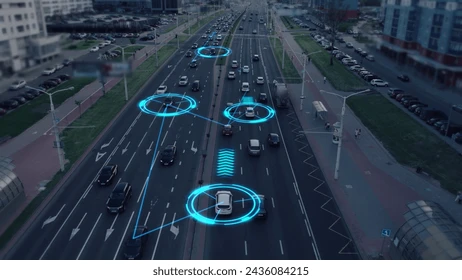
The transportation industry is on the verge of one of its greatest revolutions since the invention of the automobile. The emergence of autonomous vehicles (AVs) — self-driving cars, trucks, drones, and even ships — combined with smart transportation systems powered by data, sensors, and artificial intelligence, promises to transform how people and goods move across the world. From AI-powered cars that navigate city traffic without human intervention to smart traffic lights that optimize flow in real time, autonomous technology is redefining mobility — making it safer, cleaner, and more efficient. The U.S. and other developed nations are leading this transformation, investing billions in research, testing, and infrastructure to build a future where vehicles communicate, learn, and make split-second decisions smarter than humans ever could.
Autonomous Vehicles
An autonomous vehicle, often called a self-driving car, is one that can sense its environment, make decisions, and move safely with little or no human input. These vehicles rely on a combination of technologies — sensors, cameras, radar, GPS, and artificial intelligence — to interpret their surroundings, detect obstacles, follow routes, and react to unexpected events.
The Society of Automotive Engineers (SAE) defines six levels of vehicle automation (0 to 5):
- Level 0: No automation (traditional driving).
- Level 1: Driver assistance (adaptive cruise control).
- Level 2: Partial automation (Tesla Autopilot, Ford BlueCruise).
- Level 3: Conditional automation (driver monitors system readiness).
- Level 4: High automation (no driver input in certain areas).
- Level 5: Full automation (no steering wheel or pedals).
Most current consumer vehicles are between Levels 2 and 3, while companies like Waymo, Cruise, and Tesla are testing Level 4 vehicles in select cities.
Core Technologies Behind Autonomous Vehicles
Autonomous driving is made possible by an integrated ecosystem of advanced technologies:
A. Sensors and Cameras
- LIDAR (Light Detection and Ranging): Uses laser pulses to create 3D maps of the environment, detecting distance and shapes.
- Radar: Measures speed and position of objects, especially useful in fog or darkness.
- Cameras: Provide high-resolution visuals for lane detection, signs, and pedestrian recognition.
- Ultrasonic Sensors: Detect objects close to the car, useful for parking or tight maneuvers.
B. Artificial Intelligence (AI)
AI acts as the vehicle’s “brain.” Deep learning models analyze sensor data to identify pedestrians, vehicles, road signs, and signals. Computer vision algorithms allow vehicles to “see,” while reinforcement learning helps them make complex navigation decisions based on real-world data.
C. Mapping and Localization
Autonomous cars use HD maps and GPS to understand their exact location within a few centimeters. These maps include lane markings, traffic lights, curbs, and even speed bumps.
D. Connectivity (V2X Communication)
“Vehicle-to-Everything (V2X)” communication lets cars exchange data with other vehicles (V2V), infrastructure (V2I), pedestrians (V2P), and the cloud. This ensures smoother traffic flow and collision avoidance.
E. Cloud and Edge Computing
Vehicles send and receive massive amounts of data in real-time. Edge computing processes information locally (within milliseconds), while cloud networks store and update navigation data globally.
Smart Transportation Systems
Autonomous vehicles are part of a larger vision known as Smart Transportation, which uses data, IoT, and analytics to optimize the entire mobility ecosystem.
Key Components:
- Smart Traffic Lights: Adjust signal timing dynamically based on real-time traffic conditions.
- Connected Infrastructure: Roads embedded with sensors that communicate with vehicles about hazards or traffic.
- Mobility-as-a-Service (MaaS): Platforms integrating public transit, ride-sharing, and e-bikes into unified apps.
- Smart Parking Systems: Automatically guide drivers to available spaces, reducing congestion.
- Intelligent Public Transport: AI-managed buses, trains, and logistics systems improving punctuality and capacity.
Together, these systems create data-driven urban mobility networks — reducing emissions, accidents, and wasted time.
Major Companies and Projects in the USA
A. Waymo (Alphabet/Google)
A pioneer in self-driving technology, Waymo operates fully autonomous taxis in Phoenix, San Francisco, and Los Angeles. Its vehicles have driven over 20 million miles on public roads.
B. Tesla
Tesla’s Autopilot and Full Self-Driving (FSD) systems use cameras, neural networks, and over-the-air updates. Although not yet fully autonomous, Tesla collects massive driving data from millions of vehicles to train its AI models.
C. Cruise (General Motors)
Cruise operates robotaxis in San Francisco and is testing nationwide. The company aims for 100% electric, fully driverless vehicles integrated with city transport.
D. Aurora and Uber ATG
Aurora, founded by ex-Google, Tesla, and Uber engineers, focuses on autonomous trucking and ride-sharing.
E. Apple Project Titan
Though secretive, Apple’s autonomous project reportedly combines LiDAR systems and AI software for future vehicles.
Benefits of Autonomous Vehicles and Smart Transportation
A. Safety
Over 90% of traffic accidents are caused by human error — speeding, distraction, or fatigue. Autonomous vehicles eliminate these risks, offering predictable, rule-abiding driving behavior.
B. Reduced Congestion
With smart routing and coordinated movement, traffic flows more efficiently. V2X systems prevent bottlenecks by adjusting routes dynamically.
C. Environmental Sustainability
Autonomous fleets can drive more efficiently, reducing fuel consumption and emissions. Electric AVs, combined with renewable energy, create a zero-emission transport ecosystem.
D. Accessibility
Self-driving cars can empower elderly, disabled, and non-driving individuals to travel independently, improving social inclusion.
E. Productivity and Comfort
Without the need to focus on the road, passengers can work, rest, or enjoy entertainment during transit — redefining the purpose of travel.
Challenges and Ethical Dilemmas
Despite progress, full autonomy faces significant barriers:
A. Safety and Reliability
AI must be trained to handle unpredictable real-world scenarios — weather, human behavior, and road irregularities. Even a small software glitch could have catastrophic consequences.
B. Legal and Liability Issues
Who is responsible in a crash — the manufacturer, software developer, or passenger? Laws are still evolving to address such questions.
C. Cybersecurity
Autonomous vehicles are potential targets for hacking, data theft, or malicious control. Robust encryption and AI monitoring are essential.
D. Ethical Decisions
If an accident is unavoidable, how should the AI decide between harming passengers or pedestrians? These “trolley problem” scenarios raise moral debates about machine decision-making.
E. Infrastructure Readiness
Smart transportation requires massive investment in roads, communication networks, and data centers. Many regions still lack the necessary technology base.
Economic and Social Impacts
The AV revolution will disrupt multiple industries:
- Transportation and Logistics: Self-driving trucks and delivery robots will reduce costs and reshape supply chains.
- Insurance: Accident rates may drop dramatically, transforming the insurance model.
- Urban Planning: Fewer parking lots and traffic jams could reshape cities around walkable communities.
- Employment: Driving-related jobs (truckers, taxi drivers) may decline, while new roles emerge in AI, maintenance, and cyber safety.
According to McKinsey, the global autonomous vehicle market could exceed $2 trillion by 2035, creating millions of high-tech jobs while automating others.
The Road Ahead: Future Trends
- Level 5 Autonomy: Fully self-driving vehicles capable of operating anywhere, anytime, without human input.
- Smart Cities Integration: Seamless communication between vehicles, infrastructure, and citizens.
- Autonomous Public Transit: Self-driving buses and shuttles operating 24/7.
- AI Traffic Control: Entire city networks optimized by AI to reduce accidents and emissions.
- Electric + Autonomous Synergy: Merging EVs with autonomy for sustainable urban mobility.