





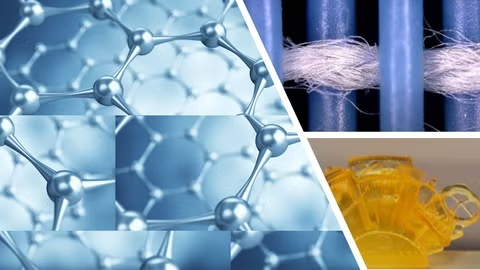
We live in an era where the boundaries between science fiction and reality are blurring — where engineers manipulate atoms, scientists build materials stronger than steel yet lighter than air, and doctors deliver medicine cell by cell. This is the power of nanotechnology and advanced materials — two interconnected fields quietly transforming medicine, energy, computing, and manufacturing at a microscopic scale. Nanotechnology is the science of manipulating matter at the nanometer level — roughly one-billionth of a meter. At this scale, materials behave in unique ways, displaying new electrical, mechanical, and chemical properties that don’t exist in their bulk forms. Advanced materials, on the other hand, refer to engineered substances designed with specific properties and performance characteristics — often using nanotechnology for enhancement. Together, they are reshaping every aspect of human progress, from self-healing surfaces to quantum computers, from targeted drug delivery to clean, renewable energy systems.
Nanotechnology.
Nanotechnology involves controlling and structuring matter at the atomic and molecular level, typically between 1–100 nanometers (for reference, a human hair is about 80,000 nanometers wide).
At this tiny scale, quantum effects dominate, giving rise to behaviors that can’t be explained by traditional physics. For example:
- Gold nanoparticles appear red or purple instead of metallic yellow.
- Carbon nanotubes are stronger than steel but lighter than aluminum.
- Nanoparticles can react faster due to their massive surface-area-to-volume ratio.
Nanoscience enables researchers to customize materials for desired properties — making them harder, more conductive, biocompatible, or responsive to stimuli.
The Science of Advanced Materials
Advanced materials are engineered to outperform traditional substances through innovation in chemistry, physics, and nanotechnology. They are categorized as:
- Smart Materials: React to external stimuli (temperature, light, pH).
- Composite Materials: Combine multiple substances for strength and flexibility.
- Biomaterials: Used in medical implants, tissue engineering, and prosthetics.
- Nanomaterials: Include nanoparticles, nanowires, nanotubes, and graphene.
These materials drive advancements in electronics, defense, aerospace, healthcare, and sustainability, often forming the foundation of 21st-century innovation.
How Nanotechnology Works
Nanotechnology operates through three core processes:
A. Top-Down Fabrication
Shrinking large materials into nanoscale dimensions using techniques like lithography, etching, or mechanical grinding — common in semiconductor manufacturing.
B. Bottom-Up Assembly
Building materials atom-by-atom or molecule-by-molecule, mimicking biological processes such as DNA synthesis. Used for creating nanostructures, quantum dots, and self-assembling materials.
C. Functionalization
Attaching specific chemical groups or molecules to nanoparticles to control how they interact with their environment — crucial for targeted drug delivery or biosensors.
Together, these methods allow precise control over material structure and behavior, unlocking entirely new capabilities.
Real-World Applications of Nanotechnology and Advanced Materials
Medicine and Healthcare
Nanotechnology is revolutionizing medicine through nanomedicine, enabling precision therapies and diagnostics at the cellular level.
- Targeted Drug Delivery: Nanoparticles carry drugs directly to diseased cells (e.g., cancer therapy), minimizing side effects.
- Imaging and Diagnostics: Quantum dots and nanosensors improve MRI and biomarker detection accuracy.
- Regenerative Medicine: Nanofibers help grow tissues and bones; nanomaterials aid wound healing.
- Wearable Biosensors: Detect glucose, oxygen, or viral presence in real-time through nanoscale transistors.
Electronics and Computing
Nanotechnology drives the miniaturization and efficiency of electronic devices.
- Nanotransistors: Essential for next-generation processors and quantum computing.
- Graphene and Carbon Nanotubes: Offer ultra-fast, flexible, and transparent electronic circuits.
- Memory and Storage: Nanomaterials enable higher density data storage and faster retrieval.
Energy and Environment
Nanomaterials are central to clean energy innovation.
- Solar Cells: Nanostructured silicon and perovskites increase light absorption and efficiency.
- Batteries: Nano-engineered electrodes (like graphene) enhance charge capacity and lifespan.
- Catalysts: Nanoparticles speed up reactions in fuel cells and pollution control systems.
- Water Purification: Nanoscale filters remove heavy metals, bacteria, and microplastics efficiently.
Aerospace and Automotive
Lightweight nanocomposites and advanced materials are improving performance and safety.
- Carbon Fiber Nanotubes: Create aircraft parts that are strong yet extremely light.
- Self-Healing Coatings: Automatically repair minor damage from impacts or corrosion.
- Thermal Insulators: Protect spacecraft and engines from extreme heat.
Construction and Infrastructure
Smart and nanostructured materials enable sustainable, durable infrastructure.
- Nano-Concrete: Stronger, more crack-resistant, and self-cleaning surfaces.
- Energy-efficient Glass: Coatings that adjust transparency and heat reflection dynamically.
- Smart Sensors: Embedded nanodevices monitor structural health in bridges and buildings.
Consumer Products
Nanotechnology enhances everyday products like:
- Textiles: Stain-resistant, antimicrobial, and UV-protective fabrics.
- Cosmetics: Nanoparticles improve absorption and stability in sunscreens and lotions.
- Food Packaging: Nanocoatings prevent spoilage and detect contamination.
Nanotechnology and Quantum Frontier
At the nanoscale, quantum mechanics begins to influence behavior. Quantum dots, for example, are nanocrystals that emit light of precise wavelengths — used in displays, imaging, and computing.
This intersection between nanotechnology and quantum science underpins quantum materials, which may enable:
- Quantum computers capable of solving complex problems exponentially faster.
- Superconductors that transmit electricity with zero loss.
- Spintronics — devices using electron spin rather than charge for ultra-efficient data storage.
Economic and Industrial Impact
The global nanotechnology market is projected to exceed $300 billion by 2030, impacting nearly every industrial sector:
- Electronics & Semiconductor Industry: $100+ billion.
- Healthcare & Pharmaceuticals: $80+ billion.
- Energy & Environment: $60+ billion.
Countries like the U.S., China, Germany, Japan, and South Korea lead in nanotechnology patents and commercialization. The U.S. National Nanotechnology Initiative (NNI) has invested billions since 2000 to accelerate research, education, and commercialization.
Challenges and Ethical Concerns
Despite its potential, nanotechnology raises scientific and ethical challenges:
A. Safety and Toxicity
Nanoparticles can enter biological systems easily. Their long-term health and environmental effects are not fully understood. Researchers are studying their biocompatibility and ecological impact.
B. Manufacturing Complexity
Producing nanomaterials at industrial scale while maintaining precision and cost-effectiveness remains difficult.
C. Ethical and Privacy Issues
Nanotechnology could enable microscopic surveillance or military weaponization, sparking debates about privacy and dual-use risks.
D. Regulatory Gaps
Regulation lags behind innovation. There are no global standards for labeling, testing, or managing nanomaterials safely.
The Future of Nanotechnology and Advanced Materials
The next decades will see nanotechnology embedded in every layer of society. Emerging trends include:
- Nano-Robotics: Microscopic robots performing surgeries or environmental cleanup.
- 4D Materials: Smart materials that change shape and function over time.
- Nano-Bio Interfaces: Direct integration of nanodevices with human cells and neurons.
- Artificial Photosynthesis: Nanocatalysts converting sunlight into fuel.
- Sustainable Manufacturing: Green nanotech reducing waste and carbon emissions.